
Connected context
Keep the customer, interaction, work and outcome linked across the operating model.
Explore the operating model, relevant capabilities and the deployment questions that matter to enterprise teams.
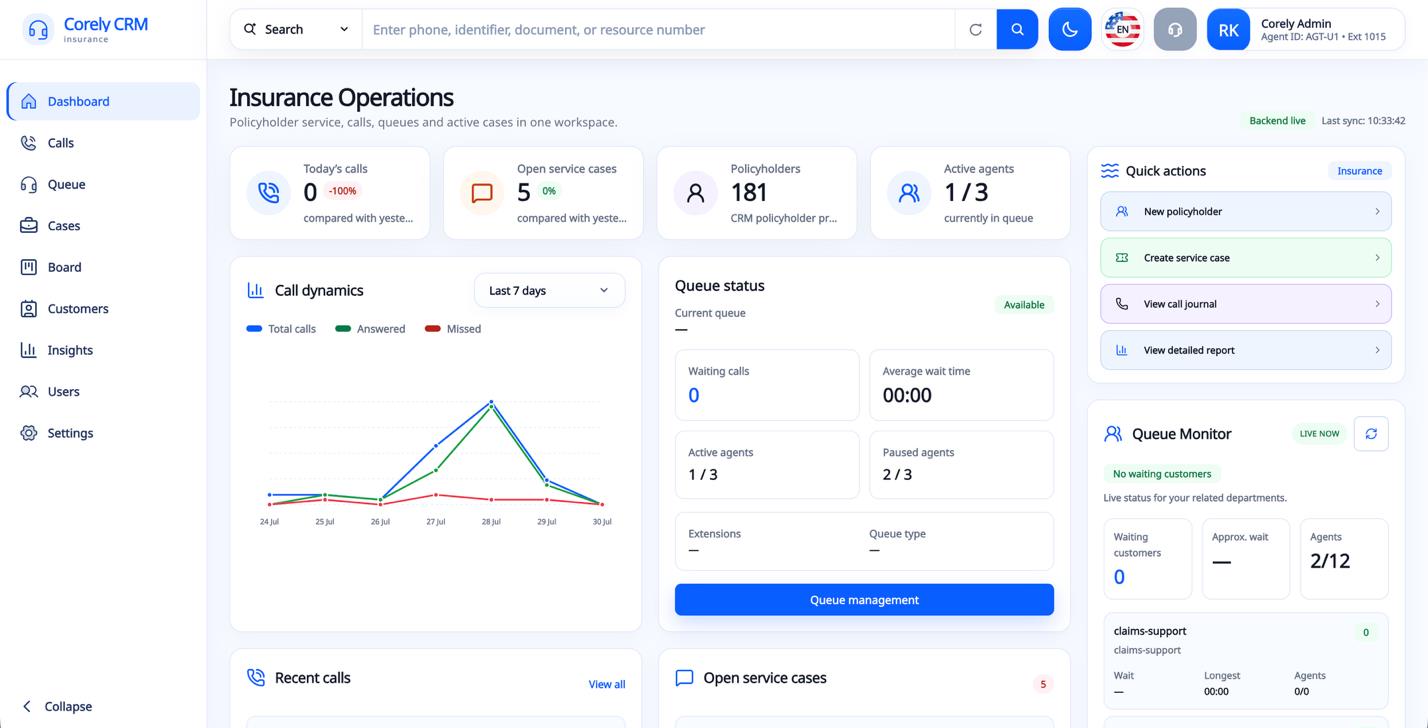
Each capability stays connected to customer context, ownership and the rest of the platform.
Keep the customer, interaction, work and outcome linked across the operating model.
Start with the product or workflow that matches the immediate business priority.
Define how Corely works alongside relevant CRM, ERP, telephony and BI systems.
Make roles, permissions, deployment and audit requirements visible from the start.
Map goals, users, workflows, systems, data and boundaries.
Agree the operating model, product scope and integration path.
Configure, test and launch the approved first release.
Measure adoption, service quality and qualified business outcomes.
Corely adapts around relevant systems, controls and industry processes rather than forcing a generic CRM template.
Explore the integration approachDirect answers, with availability and integration dependencies kept explicit.
Yes. Corely can operate as a complete customer operations platform or connect selected products to existing CRM, ERP, telephony, BI and collaboration systems. The exact integration path is confirmed during discovery.
Yes. Corely is modular. An organisation can begin with the product and workflow that solves the most urgent need, then add connected capabilities as the operating model develops.
Product scope, integrations, deployment requirements and release status are validated during a Discovery Workshop. Capabilities that depend on configuration, customer infrastructure or a controlled release are identified clearly before implementation.
Use a focused Discovery Workshop to map systems, users, data, workflows, deployment and the first measurable release.