
Case management
Create, classify, route and resolve customer and operational requests.
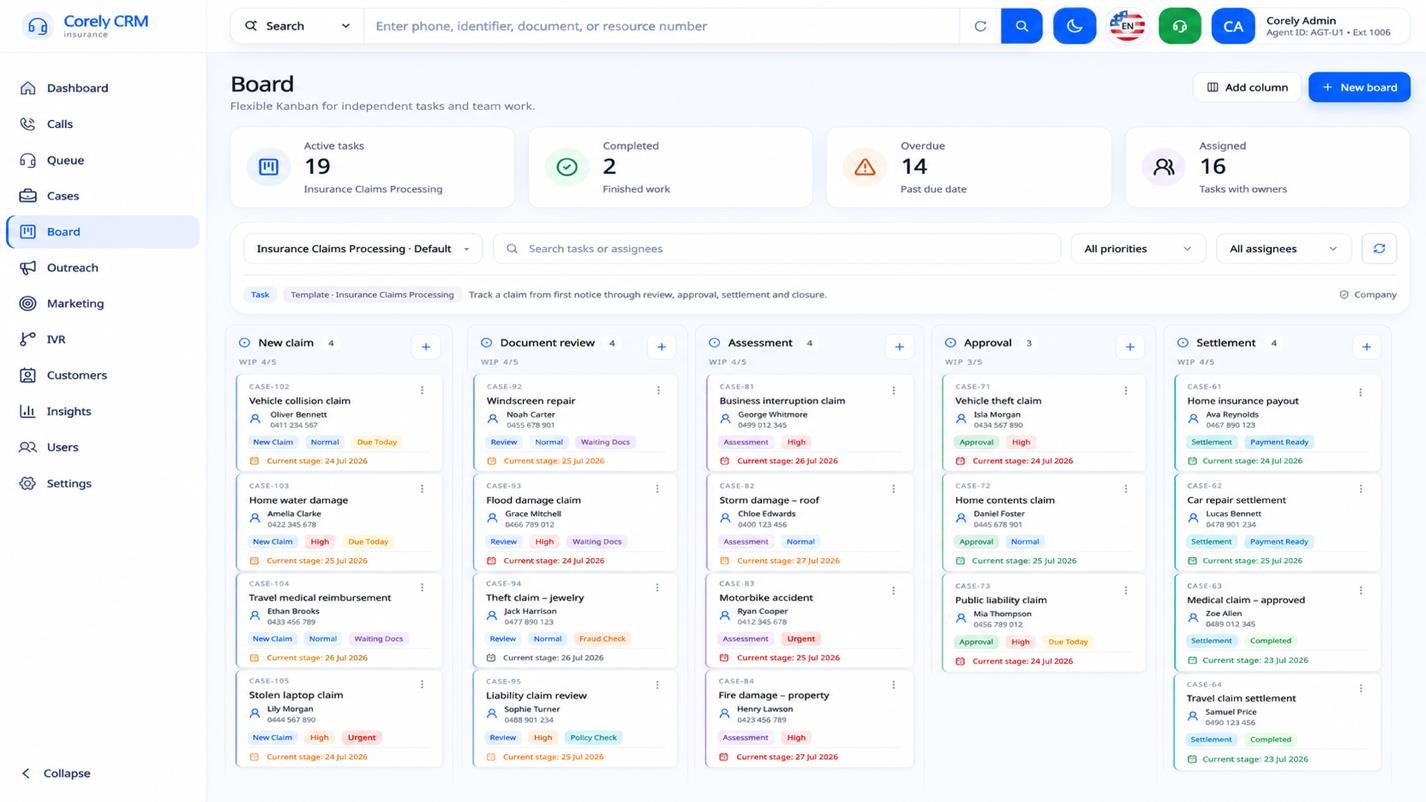
Coordinate cases, Kanban boards, tasks, approvals, checklists, SLA and cross-team workflows without losing customer context.
Each capability stays connected to customer context, ownership and the rest of the platform.
Create, classify, route and resolve customer and operational requests.
Give teams a visual workspace with ownership, priority, dates and status.
Track response and resolution targets with calendars, pauses, warnings and escalation rules.
Record requester, approver, decision and outcome in the workflow.
Create work from calls, forms, CRM events or manual intake and keep the source linked.
See workload, bottlenecks, service levels and team outcomes.
Receive a request from a call, form, customer record or team member.
Apply category, priority, ownership and the right SLA.
Coordinate tasks, documents, approvals and cross-team work.
Resolve, notify, measure and keep the complete activity trail.
Corely Work can become the execution layer around existing CRM and service systems, with ownership defined before synchronisation to prevent conflicting task states.
Explore the integration approachDirect answers, with availability and integration dependencies kept explicit.
A case represents the overall customer or operational request. Tasks are the specific actions required to move that case towards resolution.
Corely can track response and resolution targets using business calendars, stages, deadlines, warnings, pauses and escalations where configured.
Approval steps can be inserted into configured workflows with the requester, approver, status and outcome recorded.
Yes. Corely can operate as a complete customer operations platform or connect selected products to existing CRM, ERP, telephony, BI and collaboration systems. The exact integration path is confirmed during discovery.
Use a focused Discovery Workshop to map systems, users, data, workflows, deployment and the first measurable release.