
Corely CRM
Connect profiles, accounts, contacts, products, conversations, cases, documents and lifecycle activity in a governed Customer 360.
Choose Corely CRM, Call, Work, Marketing, Analytics or AI for one priority, then connect more capabilities as your operating model grows.
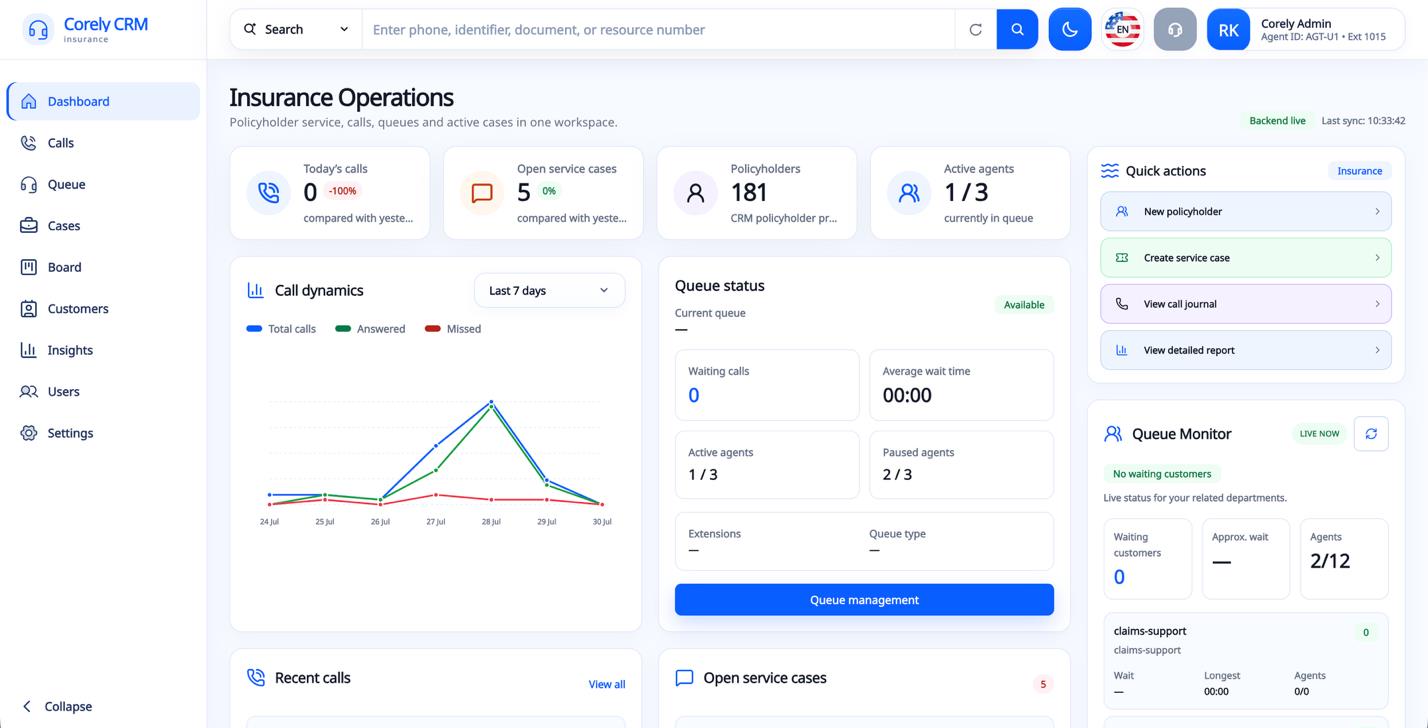
Each capability stays connected to customer context, ownership and the rest of the platform.
Connect profiles, accounts, contacts, products, conversations, cases, documents and lifecycle activity in a governed Customer 360.
Run contact-centre operations across calls, queues, recordings, routing, agent states, customer identification and operational analytics.
Coordinate cases, Kanban boards, tasks, approvals, checklists, SLA and cross-team workflows without losing customer context.
Plan connected campaigns, audiences, forms, automation and performance across the channels and data sources approved for your deployment.
Connect customer, call, case, SLA, marketing and operational data in dashboards that lead back to the underlying work.
Bring assistants, agents, analysis, call intelligence and automation to connected customer operations with controlled access and human approval.
Start with the customer operation that needs the clearest improvement.
Map existing systems, data ownership and integration boundaries.
Adapt roles, objects, workflows, reporting and deployment.
Add products without disconnecting the customer and operational context.
Corely products can run together natively or connect into an existing technology stack through confirmed integration paths.
Explore the integration approachDirect answers, with availability and integration dependencies kept explicit.
Yes. Corely can operate as a complete customer operations platform or connect selected products to existing CRM, ERP, telephony, BI and collaboration systems. The exact integration path is confirmed during discovery.
Yes. Corely is modular. An organisation can begin with the product and workflow that solves the most urgent need, then add connected capabilities as the operating model develops.
Product scope, integrations, deployment requirements and release status are validated during a Discovery Workshop. Capabilities that depend on configuration, customer infrastructure or a controlled release are identified clearly before implementation.
Use a focused Discovery Workshop to map systems, users, data, workflows, deployment and the first measurable release.