
Customer 360
Bring identity, contact details, history and relevant operational context into one usable profile.
Connect profiles, accounts, contacts, products, conversations, cases, documents and lifecycle activity in a governed Customer 360.
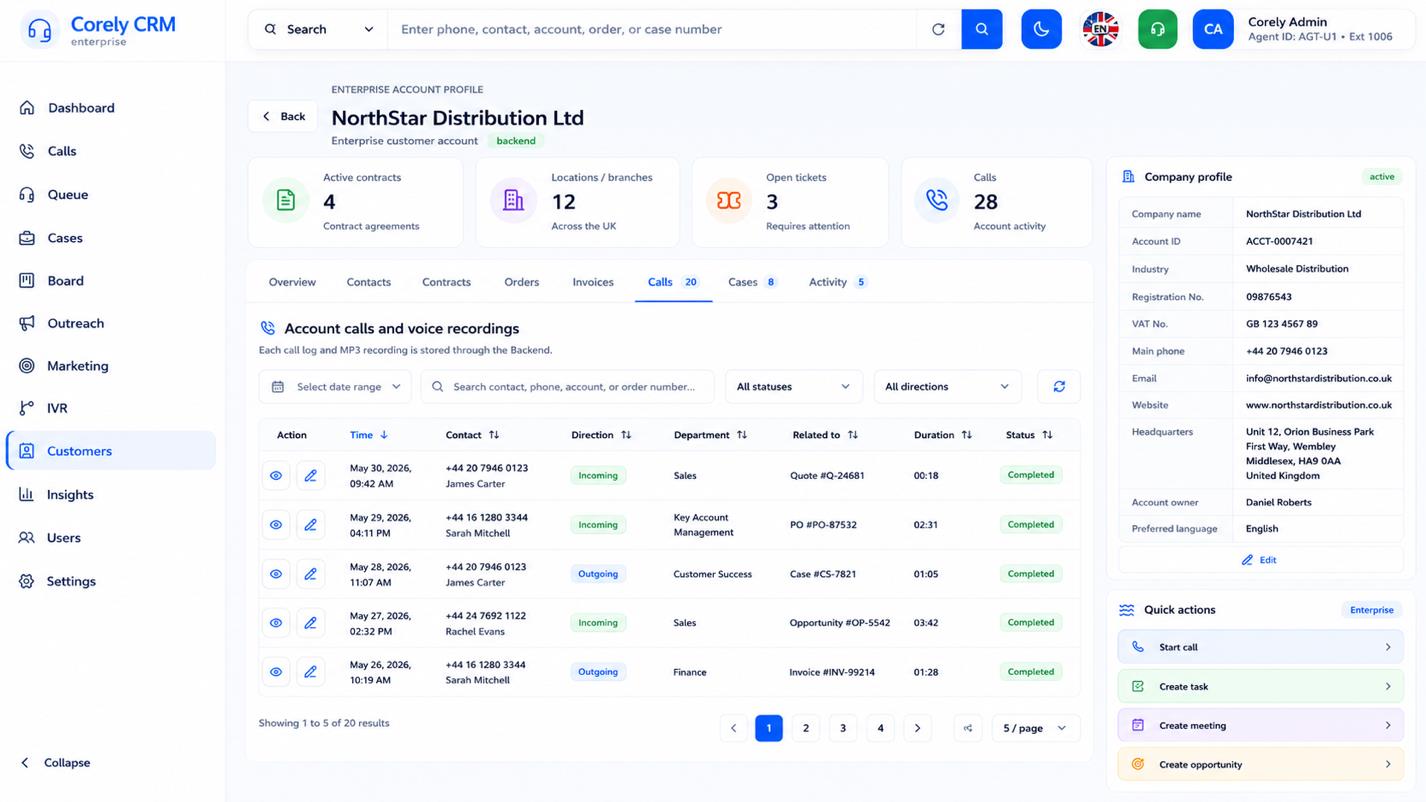
Each capability stays connected to customer context, ownership and the rest of the platform.
Bring identity, contact details, history and relevant operational context into one usable profile.
Model B2B organisations, branches, people and the relationships between them.
Keep calls, cases, tasks, notes and documents linked to the customer record.
Track opportunities, products, purchases and the next meaningful customer action.
Find customers quickly and build useful groups from permitted profile and activity data.
Add relevant objects such as policies, claims, outlets, orders or guest requests.
Resolve the person or organisation from a call, form, record or search.
See products, history, open work and recent interactions in context.
Create a case, task, opportunity or follow-up without losing the source interaction.
Use connected outcomes to improve segments, service and future actions.
Corely CRM can serve as the relevant system of record or work alongside an existing CRM through a confirmed connector, API or project integration.
Explore the integration approachDirect answers, with availability and integration dependencies kept explicit.
Customer 360 combines the customer profile with interactions, cases, products or services, notes, documents and permitted external data. The precise fields and related records follow the organisation's operating model.
Yes. Migration or synchronisation can be scoped around source systems, identifiers, duplicate handling, data quality and permissions.
Yes. Corely can model organisations, accounts, contacts, branches and related operational records.
Yes. Corely can operate as a complete customer operations platform or connect selected products to existing CRM, ERP, telephony, BI and collaboration systems. The exact integration path is confirmed during discovery.
Use a focused Discovery Workshop to map systems, users, data, workflows, deployment and the first measurable release.