
Corely CRM
Customer 360, accounts, relationships and lifecycle context.
Connect CRM, calls, service, work, marketing, analytics and AI as a native platform or alongside the systems you already use.
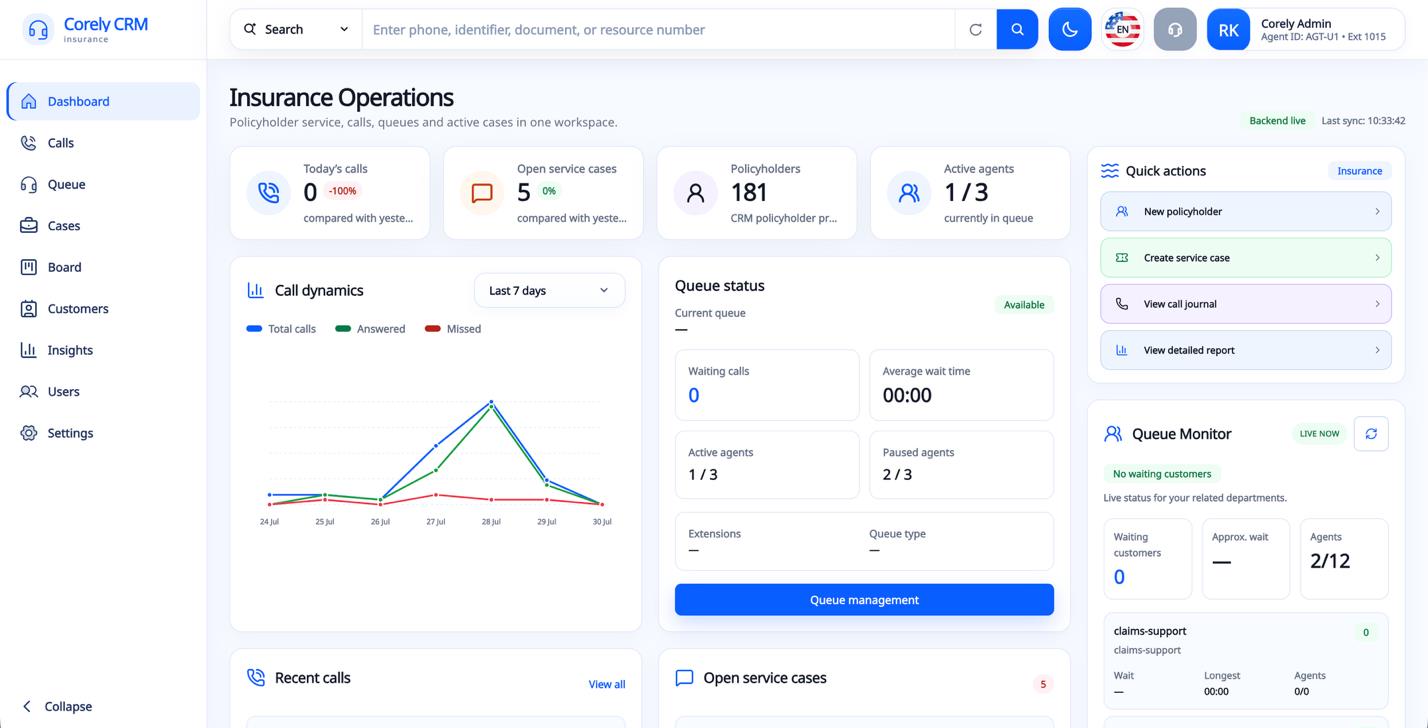
Each capability stays connected to customer context, ownership and the rest of the platform.
Customer 360, accounts, relationships and lifecycle context.
Calls, queues, routing, recordings and contact-centre operations.
Cases, tasks, approvals, SLA and workflow execution.
Audiences, campaigns, forms, automation and performance.
Cross-functional dashboards, reporting and operational insight.
Controlled assistants, agents, analysis and recommended actions.
A call, form, message or record enters the operating layer.
Corely connects the signal to the right profile and history.
A case, task, owner, approval and SLA make the action accountable.
The result becomes usable context for the next decision.
Use the complete native platform or add individual Corely products around CRM, ERP, telephony, BI and collaboration systems.
Explore the integration approachDirect answers, with availability and integration dependencies kept explicit.
Yes. Corely can operate as a complete customer operations platform or connect selected products to existing CRM, ERP, telephony, BI and collaboration systems. The exact integration path is confirmed during discovery.
Yes. Corely is modular. An organisation can begin with the product and workflow that solves the most urgent need, then add connected capabilities as the operating model develops.
Product scope, integrations, deployment requirements and release status are validated during a Discovery Workshop. Capabilities that depend on configuration, customer infrastructure or a controlled release are identified clearly before implementation.
Use a focused Discovery Workshop to map systems, users, data, workflows, deployment and the first measurable release.